When Coco Gauff was still a young junior, her coaches already knew she would become a champion.
Not because of her strokes.
Not because of her athleticism.
Not because she won more matches than the other girls.
They knew because every single training session, she gave 100%.
No matter how she felt.
No matter what happened the day before.
No matter the time of year.
That consistency — the ability to give everything she had, every day — was the single biggest separator. And the coaches around her knew, even then, that it would compound over time in a way no one else in the program could match.
⸻
Why Daily Intensity Matters More Than Talent
Coco trained in an environment filled with other talented junior girls. Many had excellent technique. Many were athletic. Many trained just as often.
But while Coco trained at 100% intensity, most of the others operated closer to 50–60% of what they were capable of giving.
That difference doesn’t look dramatic in one session.
But over weeks, months, and years, it becomes enormous.
Day after day.
Month after month.
Year after year.
While others drifted through sessions depending on mood, results, or energy levels, Coco showed up the same way every time. The coaches could see it clearly: no one else was willing — or able — to train with that level of daily commitment.
And over time, she simply separated herself more and more from the field.
⸻
Training Volume vs Training Quality
Coco’s junior training volume was high — often five to six hours per day. But it wasn’t just the number of hours that mattered. It was the intent behind them.
The same pattern appears with Iga Swiatek.
Iga trained under her longtime junior coach Michal Kaznowski from ages 9 to 16, typically spending around three hours per day on court. On paper, that’s significantly less than Coco’s volume.
But those three hours were done at full intensity, every single day.
Kaznowski has spoken about how focused and purposeful those sessions were — and how relentlessly engaged Iga was during training. Three hours at 100% intensity can easily outweigh eight or nine hours of training done at 50–60%.
Focused work compounds faster than passive repetition.
⸻
What Champions Understand at a Young Age
This is where the real lesson lies for junior tennis development.
Champions don’t just “show up.”
They actively try to get better every single day.
They want to understand:
• Why a technical change is being made
• What problem a drill is solving
• How a tactical adjustment fits into their long-term game
• What part of their development they are targeting in that session
This isn’t about slogans like “get 1% better every day.” It’s about intrinsic motivation — a deep, internal desire to improve. The best juniors are purposeful. They ask questions. They engage with the process. They don’t drift through training.
They also tend to have what elite coaches describe as “an old head on young shoulders.” They understand earlier than their peers that daily effort is what creates long-term separation.
⸻
The Rule That Changes Everything
There’s a simple rule that emerges from all of this:
If you’re too tired to train properly, don’t train.
But if you step on court, give everything you have.
That mentality — committing fully when you train and respecting recovery when you don’t — is what allows intensity to compound safely over time.
This is the difference between good juniors and future champions. And it’s something parents and coaches can actively help develop.
⸻
Where This Insight Comes From
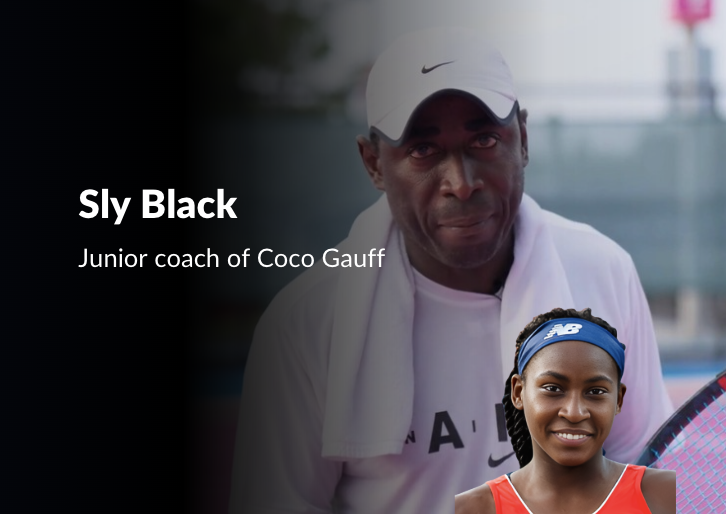
This insight comes from Sly Black, one of the greatest developmental coaches of the modern era.
Sly coached Coco Gauff from ages 6 to 14, guiding her through her most formative years. He also coached Sloane Stephens from ages 9 to 13, produced four Top 100 players from the ground up, and raised three daughters who all became World No. 1 juniors.
After leaving his highly successful academy in South Florida, Sly was recruited by the Chinese Tennis Federation, where he helped design national development systems, recruit elite juniors, and work on court with top prospects — including Quinn Zheng, who went on to become a Top 10 WTA player. Sly was partially responsible for the resurgence of Chinese women’s tennis during that period.
⸻
A Critical Technical Clarification on Coco’s Forehand
In a two-hour podcast conversation, Sly also goes deep into Coco’s technical development, particularly her forehand.
One important clarification Sly makes is that the “lock” that later appeared in Coco’s forehand was not something they worked on together. According to Sly, that lock developed after she left him at age 14, alongside a subtle grip shift, and it negatively affected her forehand for a period of time.
This distinction matters. It highlights how sensitive elite technique is during key developmental years — and how even small changes can have significant downstream effects, even for world-class athletes.
⸻
Why Sly Black’s Content Matters
Sly Black isn’t just teaching strokes. He’s teaching how champions are built — technically, tactically, and mentally.
His Coach Life content, along with the full podcast conversation, offers rare insight into what truly separates elite players long before rankings reflect it. This is knowledge you don’t get from highlight reels or match statistics. You get it from the coaches who were there at the very beginning.
Greatness isn’t accidental — it’s trained, one fully committed session at a time.
Peter Clarke
CoachLife Founder and Former Professional Player
Head Coach at the CoachLife Academy