Tennis Is Evolving: Why Ball Speed, Adaptability and Defensive Skills Matter More Than Ever
Published on
- Have the Tennis Balls Changed?
- Did Carlos Alcaraz Change the Way Players Hit the Ball?
- An Interesting Observation About Alcaraz’s Forehand
- Jannik Sinner and the Importance of Ball Quality
- Why Contrast and Situation-Specific Technique Still Matter
- The Other Major Change: Defending the Corners
- What Does All This Mean for Junior Players?
- Tennis Will Keep Evolving. Your Game Needs to Evolve With It.
Tennis is constantly evolving. The equipment changes, the players become bigger, stronger and faster, and the techniques and tactics that are successful today aren’t necessarily going to be the same in five or ten years.
Over the past few years, I’ve noticed some fascinating changes in men’s professional tennis. And after watching several professional tournaments live this year, including the Miami Open, and following the recent Paris Masters, I believe we’re seeing a significant shift in the way the game is being played.
Ball speed is becoming increasingly important. Players are hitting harder, flatter and more aggressively through the court.
But why is this happening? And more importantly, what does it mean for junior players developing their games today?
Have the Tennis Balls Changed?
For approximately six years now, I’ve been hearing professional players talk about how the tennis balls have changed.
The general feeling among many players is that the balls have become heavier and slower, making it harder to generate the same explosive kick off the court with topspin.
I recently watched a fascinating podcast interview with Felix Auger-Aliassime where this exact subject came up.
The interviewer mentioned how something seemed to change with the balls after COVID, and Felix agreed. They discussed how players are increasingly trying to hit through the court with greater ball speed, rather than relying predominantly on heavy topspin.
Felix also mentioned that players are experimenting with more powerful rackets and training specifically to generate greater pace.
It’s an interesting observation because it’s exactly what I’ve been noticing myself.
If the balls aren’t jumping off the court as much, heavy topspin becomes less effective on its own. Kick serves may not be as effective, and players need to generate more speed to hit winners or force their opponents into defensive positions.
Of course, not every tournament uses the same ball, and playing conditions vary enormously. Altitude, temperature, court surface and the specific ball being used all influence how effective different shots become.
But there’s another factor that I believe is contributing to this evolution.
Did Carlos Alcaraz Change the Way Players Hit the Ball?
When Carlos Alcaraz first arrived on the professional tour, one of the things that immediately stood out was his extraordinary ball speed.
I’d watch him and think, how is he hitting the ball that much harder than everyone else?
At times, it looked like he was generating another 20–30 km/h compared with his opponents. That’s a visual impression rather than a measured comparison, but the difference was incredible.
He was simply hitting through players.
And then I started noticing something interesting.
Over the past year, particularly watching tournaments live, I’ve seen more and more players generating that same incredible pace.
Players who previously couldn’t match Alcaraz’s ball speed are now going toe-to-toe with him in baseline rallies.
One of the things you learn from watching professional tennis live is just how different the ball looks compared with watching on television. The speed, the trajectory, the depth and the way the ball comes off the court are much easier to appreciate.
At the Miami Open this year, I was struck by how hard so many of the players were hitting.
And I wonder whether players like Alcaraz have actually helped accelerate this change.
When someone arrives on tour with such a significant weapon, everyone else has to find ways to compete.
We saw something similar with João Fonseca.
I remember watching Fonseca before he’d even broken into the world’s top 100 and being absolutely blown away by his ball speed.
It was phenomenal.
These players are showing everyone just how effective pure ball speed can be.
And when you combine that with potentially slower, heavier balls, increasingly physical athletes and more powerful rackets, it’s not surprising that the game is evolving in this direction.
An Interesting Observation About Alcaraz’s Forehand
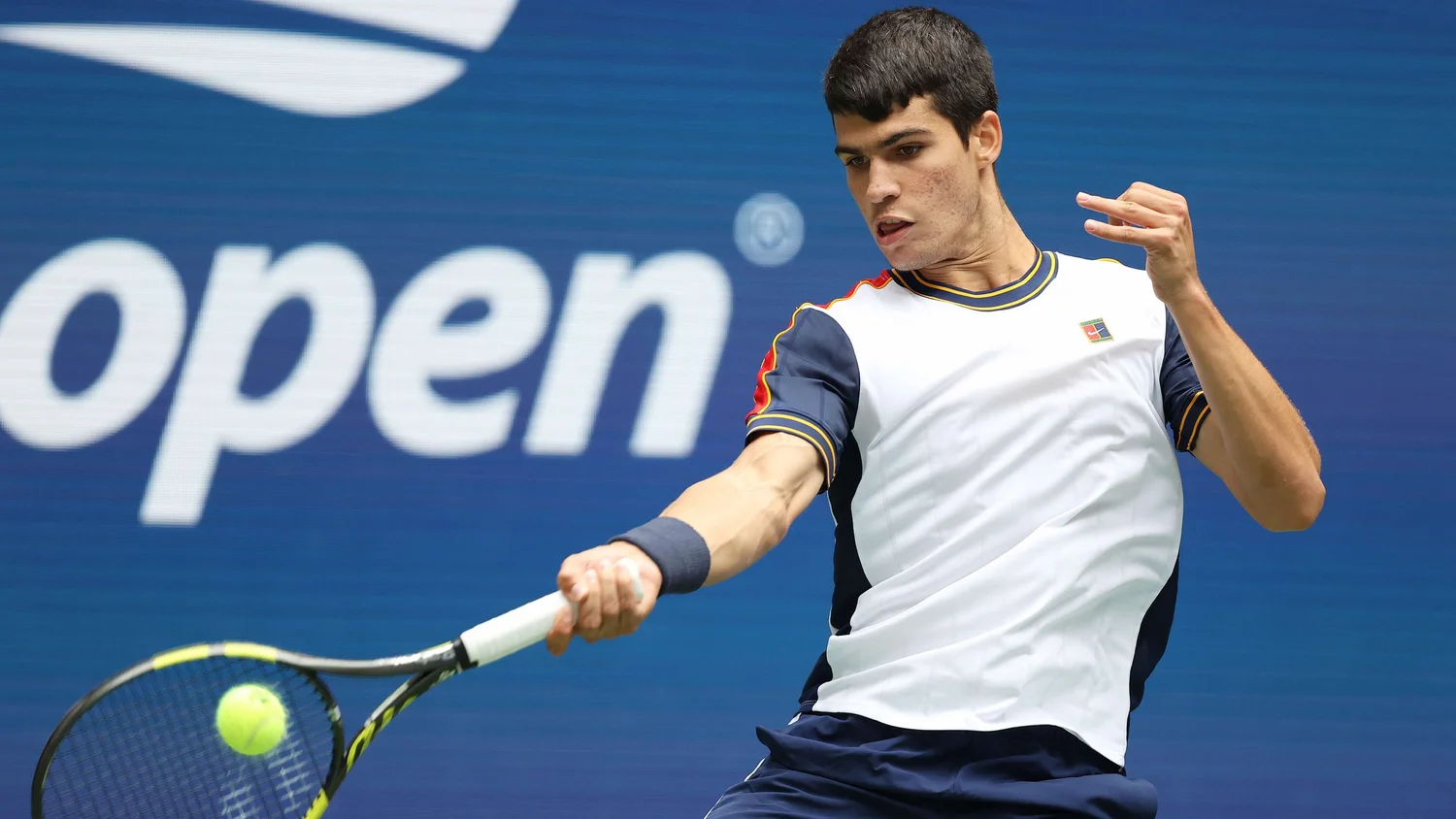
Watching Alcaraz at the recent Paris Masters, I noticed something that I found particularly interesting from a technical perspective.
His forehand didn’t appear to be quite the same devastating weapon that we’ve become accustomed to seeing.
Now, this could be related to his recent injury, his recovery, or simply a temporary adjustment in his game. I’m not suggesting there’s necessarily anything wrong with his technique.
But I noticed that his hitting arm appeared to be slightly more bent, with his elbow closer to his body, and he seemed to be using his buggy-whip forehand, with the right-side finish, less frequently.
This is interesting because Alcaraz has traditionally used a relatively straight-arm forehand, combined with an extraordinary ability to adapt his swing depending on the ball he receives.
One of the challenges of the straight-arm forehand is dealing with balls that come closer to the body.
Players like Alcaraz have developed the ability to use the buggy-whip finish incredibly effectively in these situations.
Juan Martín del Potro was another great example.
He had one of the greatest forehands in tennis history, using a relatively straight hitting arm, but he could also use the right-side finish to adapt when the ball came into his body.
Roger Federer is another obvious example of an extraordinary straight-arm forehand.
However, I’ve always believed that, when you take everything into account, a double-bend forehand can be a better overall option for many developing players.
That doesn’t mean it’s necessarily better for everyone.
Some of the greatest forehands ever have used a straighter arm, but it takes exceptional timing, athleticism, hand-eye coordination and years of practice to develop those shots to the highest level.
There are also incredibly powerful double-bend forehands.
Look at Jannik Sinner, Novak Djokovic or Fernando González.
These players demonstrate that you don’t need a straight-arm forehand to generate extraordinary power.
At Paris, I noticed that when Alcaraz had time to get around the ball, particularly on his inside-out forehand, his arm appeared straighter and he could generate that explosive pace we’re used to seeing.
But on other forehands, his elbow seemed closer to his body, and he wasn’t consistently generating the same ball speed.
I wonder whether he’s consciously making an adjustment following his injury, perhaps using the buggy-whip less because of concerns about his arm.
Or perhaps it’s simply a temporary technical change that he hasn’t fully recognized.
I don’t know the answer.
What I do know is that it was fascinating to watch.
And despite not appearing to have quite the same explosive forehand throughout the tournament, he was still finding ways to win matches.
He was using his incredible variety, drop shots, net play, speed, athleticism and court craft.
That, in itself, is another important lesson for developing players.
When one weapon isn’t working at its absolute best, having a complete game gives you other ways to win.
Jannik Sinner and the Importance of Ball Quality
At the other end of the spectrum, look at Jannik Sinner.
Sinner is one of the best examples of how devastating consistent ball quality can be.
He doesn’t necessarily rely on the same degree of variation and contrast that Alcaraz uses.
His game is built around hitting an incredibly high-quality ball, over and over again.
His shots are relatively flat, penetrating and consistently powerful.
And when you combine that with his extraordinary stability, wide base, ability to play close to the baseline and capacity to redirect pace, he’s incredibly difficult to play against.
I’ve discussed this in previous blogs.
Sinner’s ability to absorb pace, maintain his court position and redirect the ball is exceptional.
In many ways, it reminds me of Novak Djokovic.
Both players are incredibly difficult to push backwards because they’re so stable and so effective at handling pace.
Sinner demonstrates that you don’t necessarily need enormous variation in every rally if the quality of your standard ball is so high that your opponent struggles to deal with it.
But does that mean every junior player should start hitting flatter?
Absolutely not.
Why Contrast and Situation-Specific Technique Still Matter
One of the philosophies I’ve spoken about extensively at CoachLife is what I call situation-specific technique.
I believe that having a great forehand or backhand isn’t simply about being able to hit one type of ball exceptionally well.
It’s about having the complete shot.
Being able to adapt your technique to the situation you’re facing.
For example, you might hit a heavy topspin forehand that jumps up off the court, followed by a flatter, more penetrating forehand that travels through the court.
That contrast can be incredibly effective.
Players like Jack Draper and Ben Shelton are interesting examples of this, combining powerful, flatter backhands with forehands that can generate significantly more spin and kick.
Casper Ruud is another fascinating example.
Earlier in his career, Ruud was known for hitting an extremely heavy topspin forehand, almost regardless of the situation.
But his game has evolved.
He’s developed the ability to flatten the ball out more, use different finishes and hit more buggy-whip forehands.
In one rally, you might see four different forehand techniques from Casper Ruud, depending on the situation.
That’s exactly what I mean by situation-specific technique.
And it’s why I always say that developing a weapon isn’t just about having one great shot.
It’s about having a complete shot, with the ability to produce different trajectories, speeds, spins and finishes depending on what the situation requires.
Even if professional tennis continues moving towards greater ball speed and flatter hitting, I believe this adaptability will remain incredibly important.
Conditions can change.
Balls can change.
Different surfaces reward different techniques.
And the ability to adjust is what makes a player complete.
The Other Major Change: Defending the Corners
There was another part of the Felix Auger-Aliassime interview that I found particularly interesting.
The interviewer, himself a professional player, talked about the increasing importance of being able to defend the corners, particularly the backhand corner.
This really caught my attention because it’s something I’ve been thinking about extensively and had already planned to film for CoachLife in my next filming session.
As players hit harder and flatter, they’re increasingly able to drive the ball into the corners with tremendous pace.
That means the ability to defend those positions without giving up court becomes absolutely critical.
And there’s one specific shot that I believe every aspiring high-level junior player needs to develop.
The wide, open-stance recovery backhand.
When you’re pushed out wide into the backhand corner, you need the ability to take that extra step, stay low, maintain a wide base and play the shot without unnecessarily giving up ground.
Watch Djokovic.
Watch Sinner.
And watch Alcaraz.
These three players are absolutely extraordinary at this.
They can be pushed incredibly wide on the backhand side, almost into the splits, yet still maintain their balance and control.
They use an enormous lateral step, often with the outside leg extending towards the ball, while keeping their centre of gravity low.
They’re able to defend, neutralize or even counterattack from positions where most players would be forced to retreat or produce a weak reply.
And because of the way they position their bodies, they can recover back towards the middle of the court incredibly quickly.
Compare that with a player who takes several smaller steps out towards the backhand corner, loses court position and then struggles to recover.
At the highest level, that difference can determine the outcome of a rally.
Watching Alcaraz in Paris, I was struck by how often he was being pushed into defensive positions on his backhand side.
I don’t remember seeing him forced to defend that corner quite so frequently.
But his ability to get out there, stay low, maintain his court position and recover was phenomenal.
Even when opponents were hitting with tremendous pace, he was finding ways to stay in the rally and turn defence into offence.
This is one of the reasons he’s such an extraordinary player.
And I believe it’s a skill that will become even more important as ball speeds continue to increase.
At CoachLife, we’ll be adding specific technical videos and drills focused on developing this wide, open-stance backhand, including the footwork, body positioning and recovery patterns required to execute it effectively.
For junior players aspiring to play high-level college tennis or professional tennis, this is an essential skill.
What Does All This Mean for Junior Players?
I think one of the biggest mistakes in junior development is focusing entirely on what works today without considering what the game might look like in five or eight years.
If you’re coaching a talented 10-year-old, you have to think about what kind of player they’re going to become at 18.
How tall will they be?
How strong and athletic will they become?
How will their game develop physically and technically?
And just as importantly, what will professional tennis look like by then?
How big will the serves be?
How hard will players be hitting their groundstrokes?
How effective will heavy topspin be against players who are taller, stronger and more comfortable handling high balls?
The average physical profile of elite men’s tennis players has changed enormously over the years.
As players become taller, it’s naturally more difficult to consistently kick the ball above their shoulders.
That doesn’t mean heavy topspin is going to disappear.
Far from it.
But I do think the days of relying exclusively on heavy spin, without the ability to hit through the court, may be numbered at the highest levels.
Developing players need to be able to generate pace.
They need to be able to handle pace.
They need to be exceptional defensively out of the corners.
And they need the technical adaptability to change their shots depending on the situation.
However, that doesn’t mean a 10-year-old should suddenly start trying to hit every ball as hard as possible.
That’s a recipe for technical problems and potentially injury.
Power needs to be developed progressively.
Players need the appropriate physical foundations, strength, coordination and movement patterns.
And power doesn’t simply come from swinging the arm harder.
It comes from using the entire kinetic chain effectively, driving from the legs through the core and into the upper body, with coordinated movement across all three planes of motion.
This is another area we’ll be placing increasing emphasis on at CoachLife: helping players understand how to generate greater ball speed efficiently and safely.
Tennis Will Keep Evolving. Your Game Needs to Evolve With It.
What makes tennis so fascinating is that there’s never just one way to play.
We’ve seen eras dominated by serve-and-volley tennis, heavy topspin, aggressive baseline hitting and extraordinary defensive players.
And the game will continue changing.
Perhaps the balls will become faster again.
Perhaps equipment will change.
Perhaps new players will arrive with techniques or physical attributes that force everyone else to adapt.
That’s why I believe the most important thing for developing players is to build a complete game.
You need weapons, but you also need variety.
You need ball speed, but you also need control.
You need to attack, but you also need to defend and counterattack.
And you need to understand that technique isn’t one fixed movement repeated on every ball.
It’s the ability to adapt your movements and your shots to the situation in front of you.
Watching Alcaraz recently has reinforced that for me.
Even when he hasn’t appeared to be generating his absolute best forehand pace, he’s still been able to compete and win through his athleticism, variety, mentality and incredible understanding of the game.
Meanwhile, players like Sinner are demonstrating just how effective extraordinary ball quality and stability can be.
And the next generation, including players like Fonseca, is showing us that ball speed may become an even greater weapon in the years ahead.
For junior players, parents and coaches, the challenge is to recognize these changes early and prepare for them.
Because the goal isn’t simply to develop a player who can win matches today. It’s to develop a player whose game will still be effective at the highest level in five, eight or ten years.
That’s one of the things I love most about tennis.
It’s constantly evolving, and there’s always something new to learn.
Peter Clarke
Founder, CoachLife.com