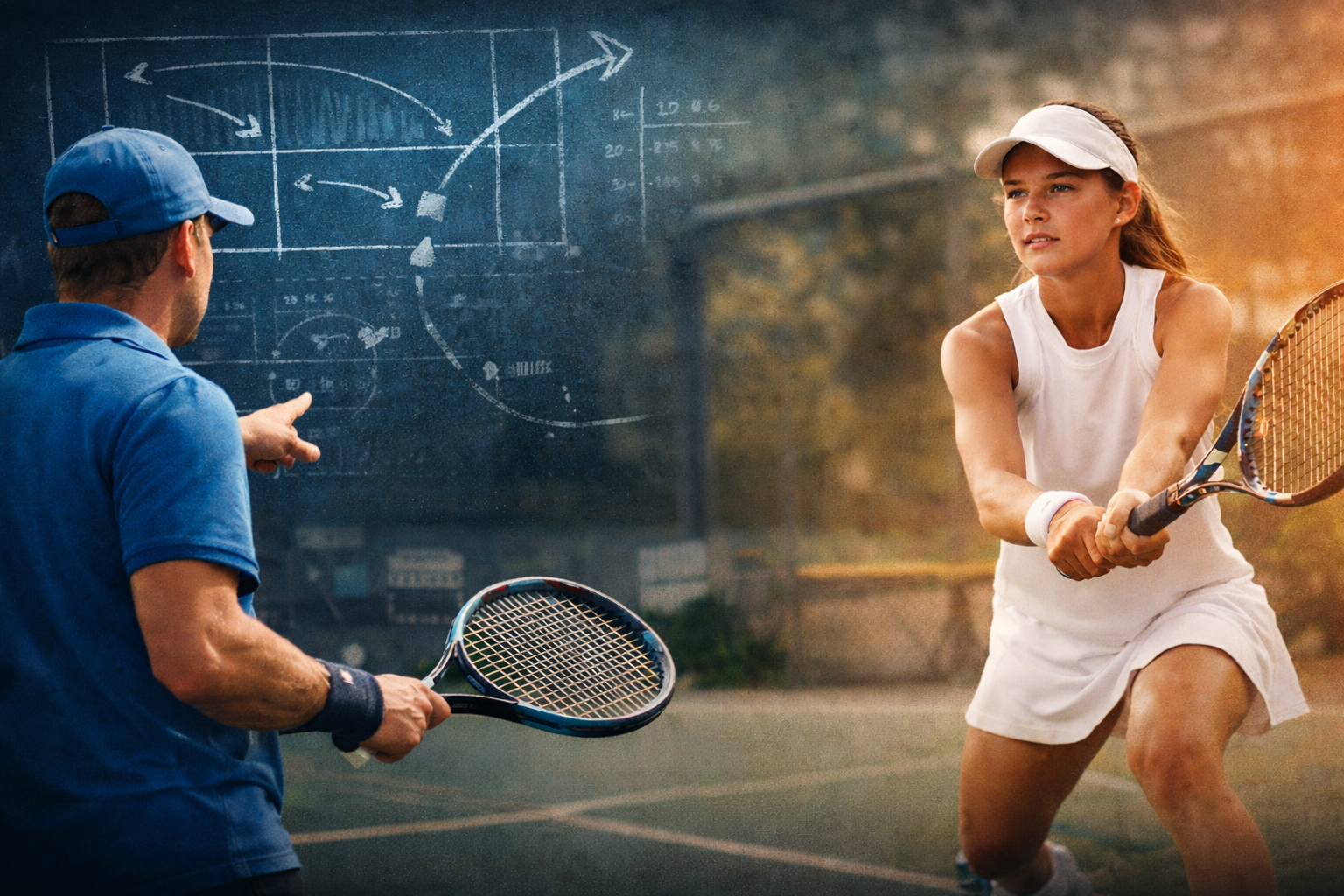
Junior Tennis Development: Lessons From Coaching Matteo Berrettini From Age 12 to the Top of the World
Published on 2/4/2026

- 1. How the Coach–Player Relationship Must Evolve in Junior Tennis Development
- 2. Technique Matters—but Over-Focusing on Technique Can Hurt Young Players
- Preserving Confidence While Developing “Weak” Shots
- Why Having Plan B and Plan C Is Essential in Tennis
- The Buggy Whip Forehand and What’s Coming Next on Coach Life
As a follow-up to the email I recently sent about our exciting new shoot in Rome during the week of February 16th, I wanted to share a few early insights from our upcoming project with Vincenzo Santopadre.
Vincenzo was the junior coach—and longtime coach—of Matteo Berrettini, starting when Matteo was just 12 years old and guiding him all the way to a Wimbledon final and a career-high ranking inside the world’s top five. He is widely regarded as one of the best junior tennis development coaches in the world. 
We recently got off a 90-minute call, and the insights he shared were exceptional. Two themes stood out in particular—both of which are critical for junior players, parents, and coaches focused on long-term tennis development.
⸻
1. How the Coach–Player Relationship Must Evolve in Junior Tennis Development
One of the most fascinating aspects of Vincenzo’s journey with Matteo is how their relationship evolved over time.
In junior tennis, the coach–player dynamic is never static. How you coach a 12-year-old is completely different from how you coach a 14-year-old, which is different again at 16, 18, and eventually adulthood.
Early on, a junior coach often plays a father-figure or mentor role, providing structure, guidance, and emotional stability. But as players mature—physically, mentally, and emotionally—that dynamic must change. By the time a player becomes a man and a professional athlete, the relationship needs to be far more collaborative, respectful, and based on trust.
Vincenzo coached Matteo not only as a junior but also as a professional competing at the very highest level of the sport. Understanding how to communicate, how to deliver feedback, and how to adjust your leadership style at each stage is one of the true arts of elite junior tennis development.
In many cases, how you say something matters far more than what you say. Message delivery, timing, tone, and collaboration are often the difference between a player improving—or tuning out completely.
⸻
2. Technique Matters—but Over-Focusing on Technique Can Hurt Young Players
Another powerful insight Vincenzo shared was the danger of becoming overly obsessed with technique, particularly in junior tennis.
There’s no question that solid fundamentals and sound technique are essential in long-term player development. However, how technique is taught and discussed matters enormously.
When young players become conditioned to immediately blame missed shots on “bad technique,” it can severely damage their confidence in matches. A forehand or serve going off doesn’t always mean there’s a technical flaw.
There are countless reasons why a shot might break down on a given day:
• Mental pressure
• Fatigue or physical load
• Footwork and court positioning
• Matchups and opponent styles
• Ball conditions or court speed
If players default straight to technical thinking every time they miss, they often mentally spiral. This is how technically sound players can still struggle with mental toughness, resilience, and problem-solving under pressure.
Great junior tennis development teaches players how to win matches even when things aren’t perfect.
⸻
Preserving Confidence While Developing “Weak” Shots
Vincenzo also touched on something every tennis parent and coach should understand:
You absolutely want to improve a player’s weaker shots—but how you frame that work is critical.
Constantly labeling a forehand, serve, or backhand as a “huge weakness” can create long-term negativity around that shot. Once that happens, as soon as the shot breaks down in a match, the player’s confidence often collapses with it.
Instead, the healthiest approach is:
• Acknowledge areas for improvement
• Work on them progressively over time
• Keep language constructive and forward-looking
• Avoid emotional or catastrophic framing
This allows players to continue developing other parts of their game—tactics, movement, competitiveness, creativity—rather than becoming mentally trapped by one perceived flaw.
⸻
Why Having Plan B and Plan C Is Essential in Tennis
This philosophy ties directly into something I’ve believed for decades as a former professional player and now the founder of Coach Life.
If one shot isn’t working on a given day, players need options.
When I played professionally, my forehand was one of my biggest weapons. But when my standard forehand timing was off, I relied heavily on the buggy whip (right-side finish) forehand to stay aggressive and control points.
The same applies across the game:
• If your flat serve isn’t working, lean on kick or slice
• If your backhand is breaking down, use the slice to stay in points
• If baseline rhythm is off, transition forward or serve-and-volley
This adaptability is a core trait of mentally tough players—and it must be developed early in junior tennis.
⸻
The Buggy Whip Forehand and What’s Coming Next on Coach Life
This is also why I’m incredibly excited about two upcoming shoots.
First, our Rome shoot with Vincenzo Santopadre will offer a rare, in-depth look at long-term junior tennis development from age 12 to world-class professional—something very few coaches on the planet can truly speak to.
Second, next week I’ll be filming an advanced deep-dive on the buggy whip forehand exclusively for Coach Life subscribers. This will go far beyond surface-level instruction and break down variations, usage, decision-making, and who should and shouldn’t use it.
When I first spoke with Robert Lansdorf—who coached Pete Sampras, Maria Sharapova, and Lindsay Davenport—we spent nearly three hours discussing this forehand alone. We shared the same belief in its importance, its variations, and its role in long-term player confidence.
I’ve believed in this shot since I was 16 years old—and I’m excited to finally pass that knowledge on in full.
⸻
Final Thought
Great junior tennis development isn’t just about strokes and drills. It’s about communication, confidence, adaptability, and long-term thinking. These are the lessons we’ll continue to bring to the Coach Life community through the world’s best junior coaches.
Stay tuned—this next phase of content is going to be special.
Peter Clarke
CoachLife Founder and Former Professional Player
Head Coach at the CoachLife Academy